5 Strategies to Teach Math Vocabulary
Mathematics is a language of its own. No matter what grade you teach, there are always new math vocabulary words to learn as students explore different concepts.
From words like “square” to “derivative,” vocabulary is an important part of learning mathematics.
Teaching math vocabulary helps students understand word problems and the concepts behind them. Introducing vocabulary in student-friendly language is also helpful for English language learners.
Here are five strategies I used to help students understand and use math vocabulary.
1. Use Precise Language
Encourage precise mathematical language in your classroom. The more students hear and use correct vocabulary, the more familiar those words become.
I started focusing on precise vocabulary a few years into teaching, and I noticed a difference. My students started sounding like mathematicians, and it was music to my ears.
For example, instead of only saying “zero point three,” encourage students to also say “three-tenths” to emphasize place value.
Instead of “one over four,” use “one-fourth.” Instead of “corners,” introduce “vertices.” Instead of “bottom number,” use “denominator.”
Using precise vocabulary consistently helps students develop the language they need to explain mathematical ideas.
2. Build on What Students Already Know
When introducing a new vocabulary term, ask students what they already know about the word, shape, or concept. Use that knowledge as a starting point.
For example, when introducing dilation, you might discuss what happens to your pupils when your eyes are dilated.
For reflection, students may already be familiar with a mirror image. Discuss that idea before connecting it to geometric reflections.
Building on prior knowledge helps students make connections that support understanding and retention.
3. Use Graphic Organizers
Graphic organizers are a helpful strategy for learning math vocabulary. I particularly like the Frayer model.
Students write the vocabulary term in the center and then include a definition, visual representation, example, and non-example. This also provides useful support for English language learners.

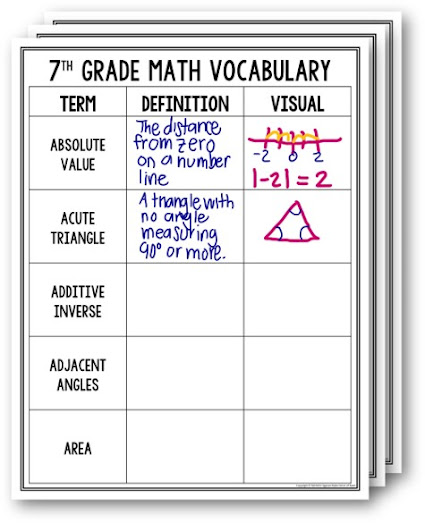
4. Draw the Vocabulary Words
Have you ever asked students to create a visual representation of a vocabulary word?
Drawing a mathematical idea helps students connect the words to something they can see. The sketches don't need to be elaborate.
For example, a number line drawing can help students understand the meaning of a number line beyond memorizing its definition.
Visual representations on a math word wall can also be helpful.
5. Make Math Vocabulary Fun
I love using math vocabulary games to help students practice new terms. Students get opportunities to recall definitions, discuss meanings, and use vocabulary while playing.
Some of my favorite vocabulary games include:
- Pictionary
- I Have, Who Has?
- MATHO (a math version of Bingo)
These games can be used in small groups or with the whole class.

Math Vocabulary Activities by Grade Level
If you'd like ready-to-use math vocabulary games and activities for your classroom, choose your grade level below.
- 6th Grade Math Vocabulary Activities and Games
- 7th Grade Math Vocabulary Activities and Games
- 8th Grade Math Vocabulary Activities and Games
In Summary
To help students develop mathematical vocabulary, use precise language, build on prior knowledge, incorporate graphic organizers, encourage drawings, and practice through games.
These strategies can be incorporated into existing lessons and can help students make sense of both math vocabulary and the concepts behind it.
Save These Math Vocabulary Strategies
Save this article to your math teaching Pinterest board for ideas on teaching vocabulary in middle school.